
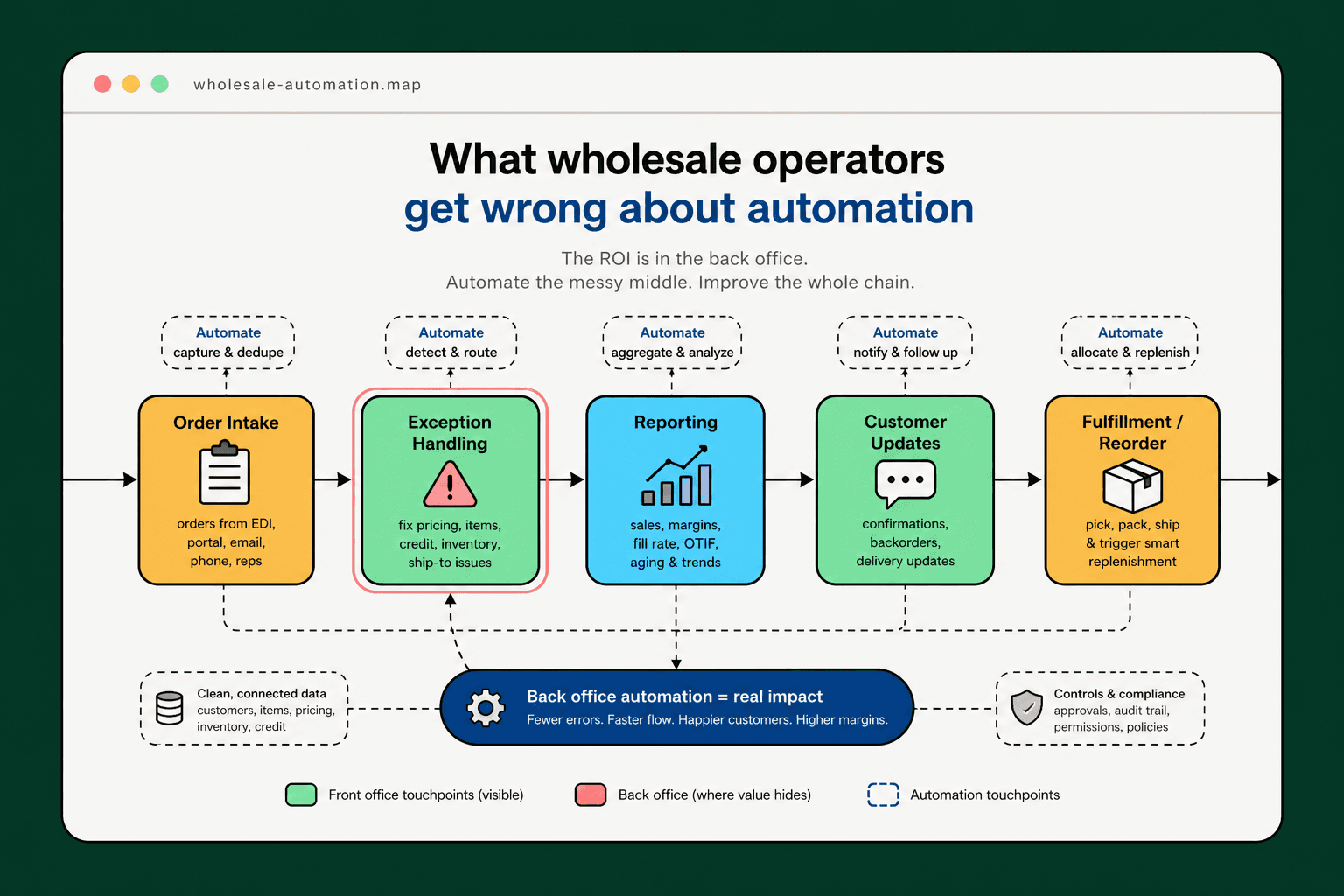
Mistake 1: Automating the showroom before the back office
Wholesale operators often want to start automation with customer-facing features — a better order portal, a smarter product search, a personalized catalog. These are visible improvements that feel strategic.
The back office — order exception processing, fulfillment tracking, invoice reconciliation, reorder triggering — is where the actual hours are lost. A wholesale operation that saves 14 hours a week on exception handling has recovered more capacity than any showroom upgrade will produce.
Mistake 2: Treating reporting as a necessary evil instead of an automation target
Weekly sales reports, inventory status summaries, buyer account reviews, and shipping exception logs are almost universally produced by a human who pulls data from multiple systems, formats it, and distributes it to a list.
This work is almost entirely automatable. The human in the loop is usually there because nobody designed the automation — not because the task requires human judgment.
Mistake 3: Leaving customer communication to the highest-paid people
In many wholesale businesses, the most experienced operators spend a significant portion of their week on routine customer communication: order status updates, shipping delays, backorder notifications, and reorder reminders.
Automating routine communication with appropriate personalization — using the account context, order history, and relationship signals that already exist in the CRM — frees experienced operators for the strategic customer conversations that require their expertise.
Where the ROI actually is
The highest-ROI automation targets in wholesale are the ones that generate the most complaints internally: order exceptions, report generation, status communications, and reconciliation tasks.
These are high-complaint targets because they are repetitive, rule-driven, and clearly defined. That is also exactly what makes them good automation candidates.
Building the capacity for growth
A wholesale business that automates its operational backbone creates a different kind of headroom. The team that was processing exceptions can focus on accounts. The operator writing reports can focus on the trends the reports reveal.
The capacity benefit of back-office automation is not just efficiency — it is organizational attention shifted to the work that actually grows the business.
Ready to act?