
The visibility trap
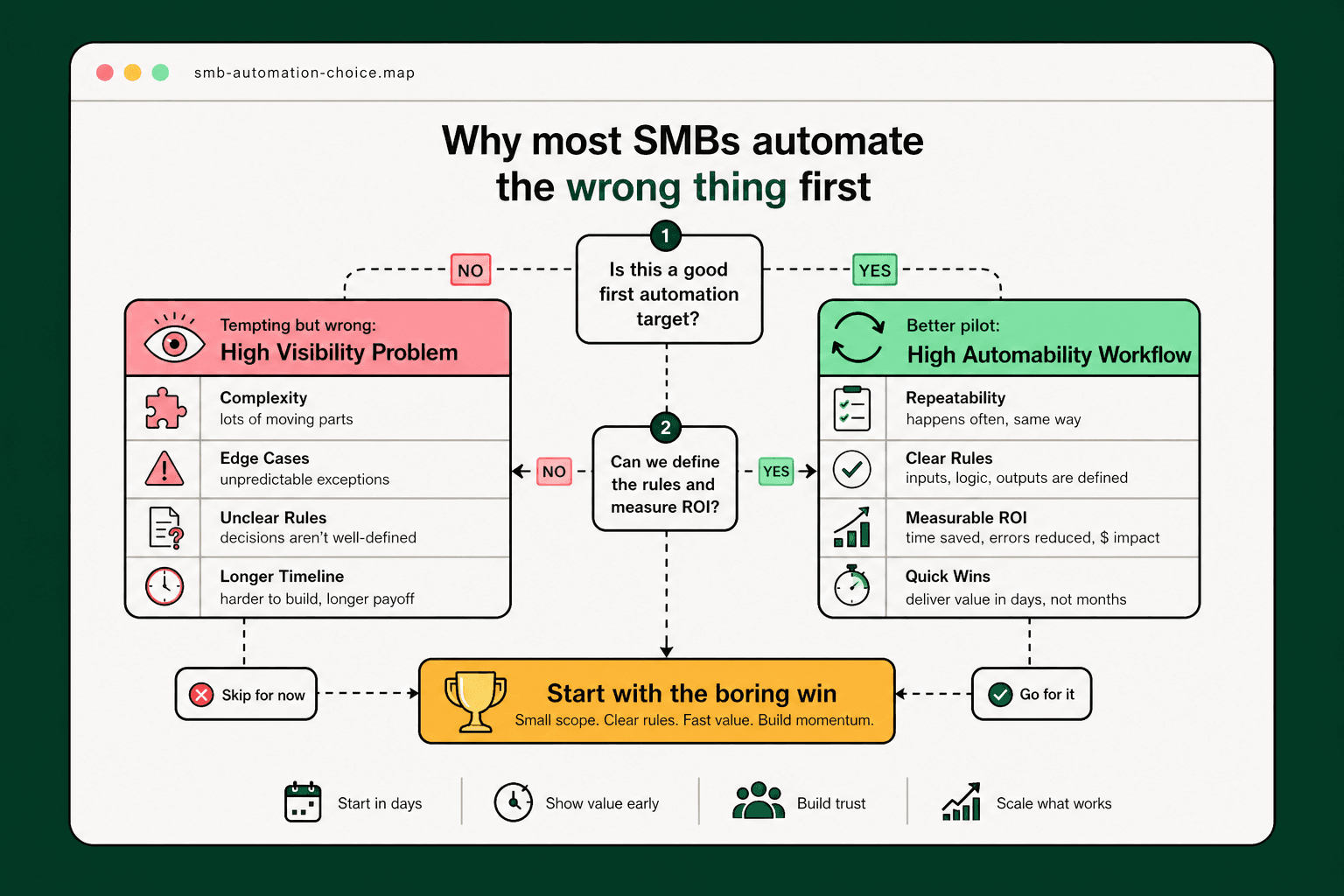
When leadership asks for AI automation proposals, teams naturally surface the most visible problems — customer-facing bottlenecks, complex decisions, anything that generates complaints.
The problem is that visible problems are usually visible because they are hard. They involve judgment calls, exception handling, edge cases, and context that has never been written down. They are the wrong place to start.
What makes a workflow actually automatable
Automatable workflows have three properties: the inputs are consistent, the logic is documentable, and the outputs can be verified by a human in under 30 seconds.
Lead routing based on company size and industry fits that description. Writing a custom pitch for each incoming lead does not. Triaging support tickets into priority queues fits. Resolving support tickets autonomously does not — not yet.
The cost of a bad first pilot
When the first AI pilot fails — because it was too complex, too subjective, or too dependent on institutional knowledge that never got documented — teams draw the wrong conclusion.
The conclusion should be 'we picked the wrong workflow.' Instead, it is usually 'AI is not ready for our business.' That belief can delay real automation by 12-24 months in a business where the right pilots would have been shipping in week six.
The right starting criteria
Before picking an automation target, ask: Does this happen more than 20 times a week? Can someone write the decision rules on a whiteboard in 15 minutes? Are the tools and data it needs already accessible? Would a 10% error rate still save time versus doing it manually?
If all four answers are yes, it belongs in the pilot queue. If any answer is no, it needs more discovery work before it becomes an automation project.
How to build momentum instead of skepticism
The right first pilot creates a success story that earns the next budget cycle. It does not need to be transformational — it needs to be demonstrable. A workflow that saves three hours a week and runs without incident for 60 days is worth more than an ambitious project that stalls.
Start with the boring win. The impressive automations become possible after the organization learns what good looks like.
Ready to act?