
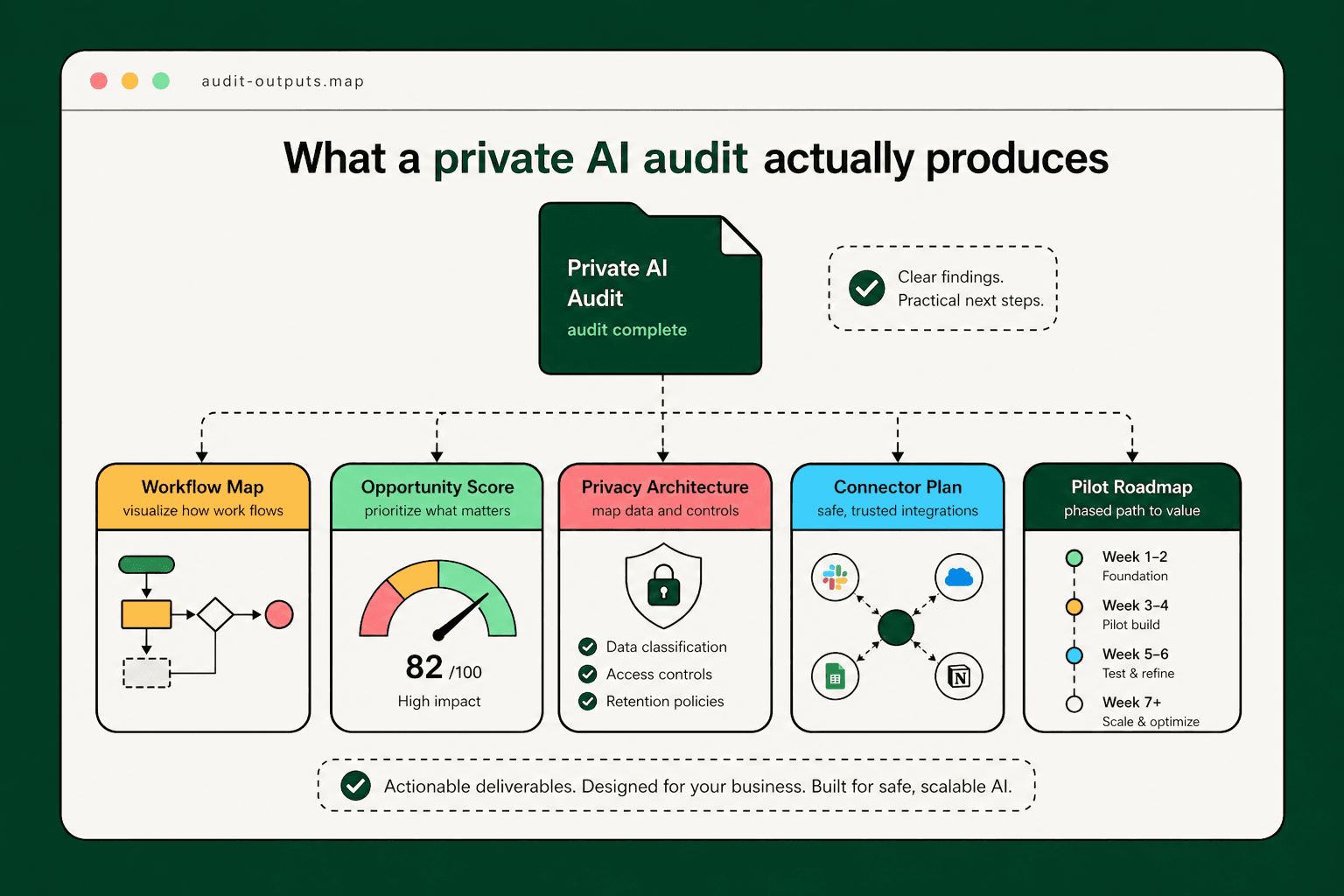
What most businesses expect versus what they need
Most business owners expect an AI audit to produce a report that says 'here are the AI tools you could use.' What they need is a map of where automation creates value in their specific operations, paired with a realistic plan for getting there.
The difference between those two outputs is the difference between another consultant's deck and an actual operating decision.
The workflow map
The first deliverable is a visual map of every candidate workflow — what triggers it, what data it needs, what tools it touches, and where a human currently makes a judgment call.
This map is valuable before any automation is built because it forces documentation of processes that usually live only in people's heads. When a key operator leaves, that documented map is worth more than any software the business bought.
The automation opportunity score
Each workflow gets scored on four dimensions: volume (how often it happens), automability (how rule-driven the logic is), connectivity (how accessible the required data is), and impact (how much time or money the automation would save).
The score is not an academic exercise. It creates a prioritized backlog that can be defended to a finance team and communicated to an operations team without requiring AI expertise to understand.
The privacy architecture recommendation
For each workflow that makes the pilot list, the audit produces a privacy recommendation: which model tier is appropriate (private, client-hosted, or approved external), what data should never leave the local environment, and what approval rules apply to automated actions.
This is the output that prevents the compliance conversation six months later. It is also the output that most 'AI strategy' engagements skip entirely.
The pilot roadmap
The final deliverable is a concrete roadmap: which workflows to build first, what the connector plan looks like, what the estimated build time is, and what the measurable success criteria are.
A good pilot roadmap includes a 30-day checkpoint with specific metrics — not 'the team feels better about AI' but 'support ticket triage time dropped from 4 hours to 45 minutes per week.'
Ready to act?