
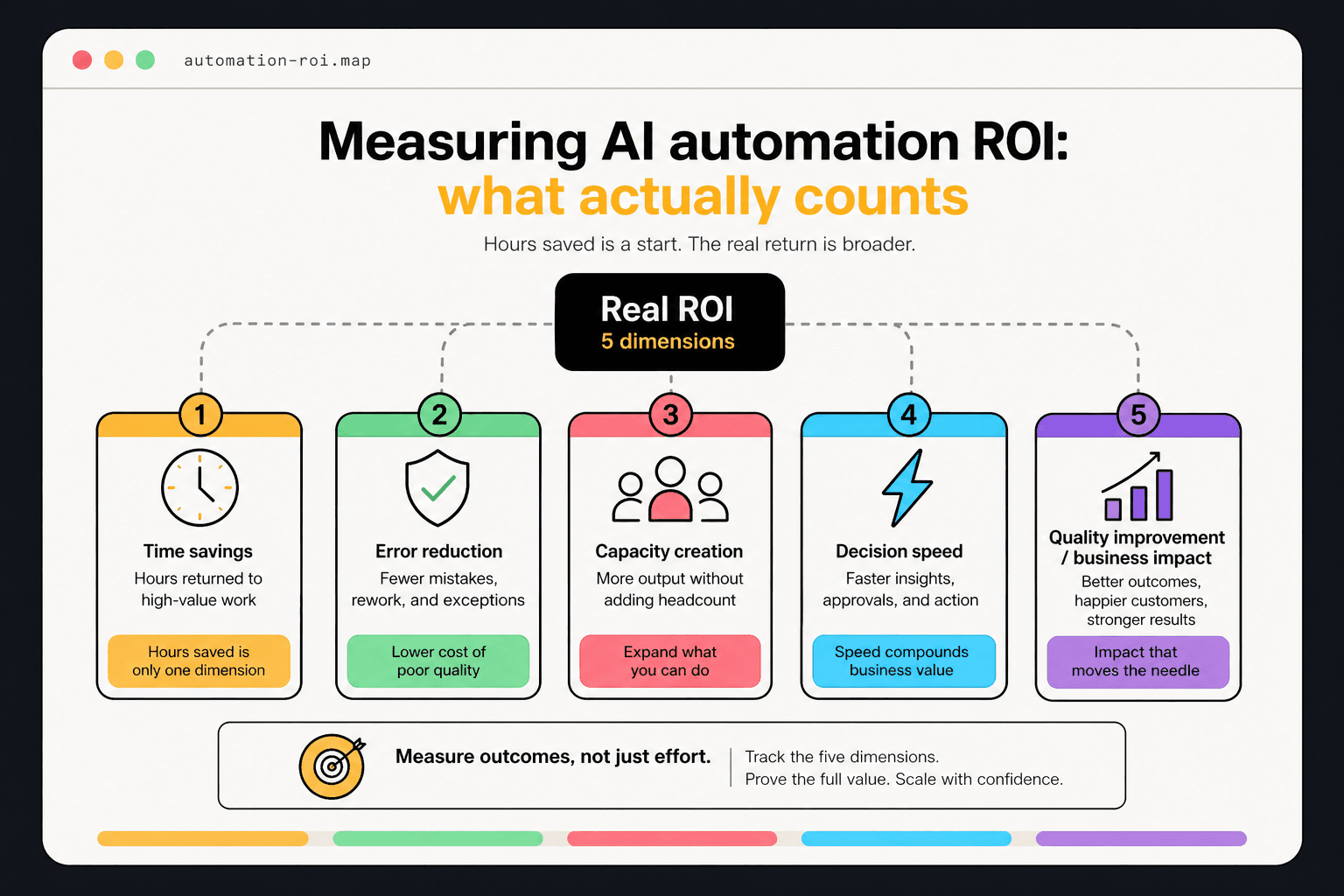
The hours-saved trap
When an automation saves 10 hours a week, the standard ROI calculation multiplies those hours by a loaded hourly rate and produces an annual saving. This number looks good in a budget presentation.
The problem is that it overstates one dimension and ignores four others. The 10 hours saved are real, but the people who saved them often spend those hours on different work, not less work. The real question is: what did the organization do with the capacity it recovered?
Dimension 2: Error rate reduction
Manual processes have error rates. Data entry errors, routing mistakes, missed approvals, and incorrect calculations all have costs: rework time, customer dissatisfaction, compliance issues, and occasionally financial losses.
An automation that eliminates a process with a 4% error rate does not just save time — it eliminates the downstream cost of every error that process was producing. For high-volume workflows, this can exceed the time-saving ROI by a significant margin.
Dimension 3: Capacity creation
The most strategically valuable ROI from automation is not efficiency — it is capacity. When the team that was processing order exceptions for 20 hours a week is no longer doing that work, what can they do instead?
Businesses that answer this question intentionally — by identifying the higher-value work that becomes possible when capacity is freed — capture the real return. Businesses that let the capacity diffuse into miscellaneous tasks capture only the efficiency saving.
Dimension 4: Decision speed
Many business decisions are made slowly because the data required to make them takes time to gather and format. A weekly report that takes three hours to produce means decisions informed by that data are made once a week.
Automation that generates real-time or daily decision-relevant data does not just save the reporting time — it accelerates the business's ability to respond to what is actually happening. In competitive markets, that acceleration is worth measuring.
Building an ROI framework that survives a CFO conversation
A credible ROI framework for AI automation includes: direct labor hours saved (at fully loaded cost), error reduction (at average cost per error), new revenue or capacity captured (with conservative assumptions), and a time-to-value estimate based on the first checkpoint of the pilot.
The framework does not need to be perfect. It needs to be honest, specific, and tied to measurements that can be verified after the automation ships. That makes it a business case rather than a wish.
Ready to act?