
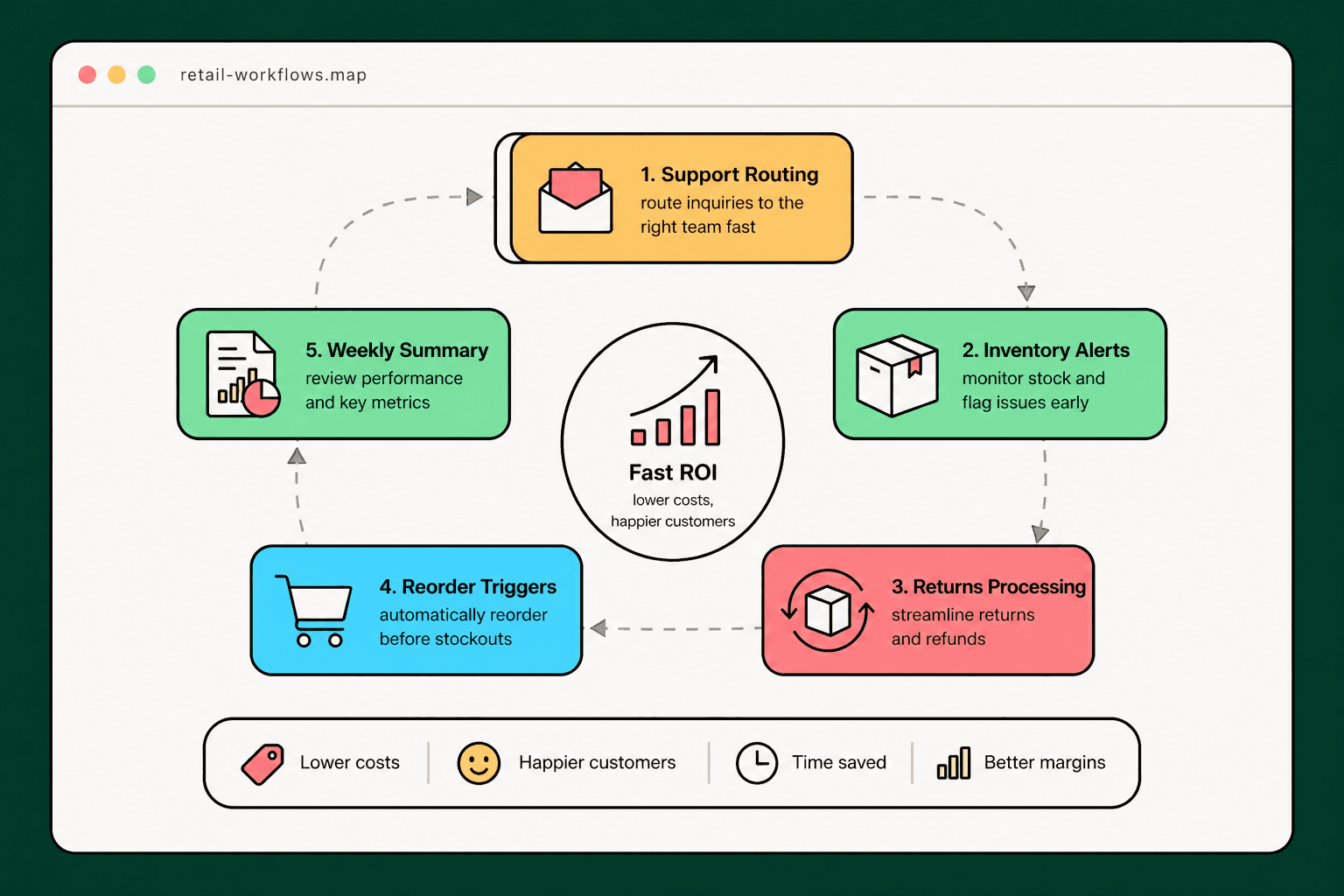
Workflow 1: Support ticket classification and routing
Every retail operation with more than 50 orders a week handles support volume that requires triaging: order status questions, return requests, product questions, complaints, and fraud flags all arrive in the same inbox.
An AI classification layer that reads each incoming ticket, assigns a category and priority, and routes it to the right queue saves 3-6 hours per week at 100 tickets and scales proportionally. It also eliminates the delay between a customer sending a message and that message reaching someone who can help.
Workflow 2: Inventory threshold alerts with purchase recommendations
Stockouts cost retail businesses an average of 4-8% of potential revenue. Most stockouts are predictable — inventory data shows the trajectory before the item runs out.
An automation that monitors inventory levels, identifies items approaching threshold, calculates reorder quantities based on lead time and sales velocity, and surfaces a purchase recommendation for human approval prevents most of that loss. The human still approves the purchase; the automation does the math.
Workflow 3: Return processing and refund triggering
Returns are operationally expensive because they involve multiple systems: order management, inventory, payment processing, and customer communication — all triggered by one customer action.
An automation that coordinates the return workflow — verifying eligibility, generating return labels, triggering the refund or exchange, updating inventory, and sending the customer confirmation — compresses a process that typically takes 24-72 hours to under 15 minutes.
Workflow 4: Reorder trigger automation for top sellers
For retail businesses with a core catalog of reliable sellers, reorder timing is a high-value decision made under time pressure. Buyers are often managing 50-200 SKUs simultaneously, and the signals that a product needs reordering are buried in multiple reports.
An automation that monitors sell-through velocity, supplier lead times, and on-hand quantity, then flags items for reorder with pre-filled purchase quantities, converts a reactive task into a proactive process.
Workflow 5: Weekly performance summary generation
Most retail operators generate a weekly performance summary: revenue versus target, top sellers, inventory alerts, and customer satisfaction metrics. This summary is almost entirely generated from data that is already in the systems — it just requires someone to pull it together.
An automation that generates this summary automatically, formats it for the appropriate audience, and delivers it at the right time each week eliminates a recurring task that typically takes 1.5-3 hours and often involves the highest-paid people in the operation.
Ready to act?