
What an AI tool is
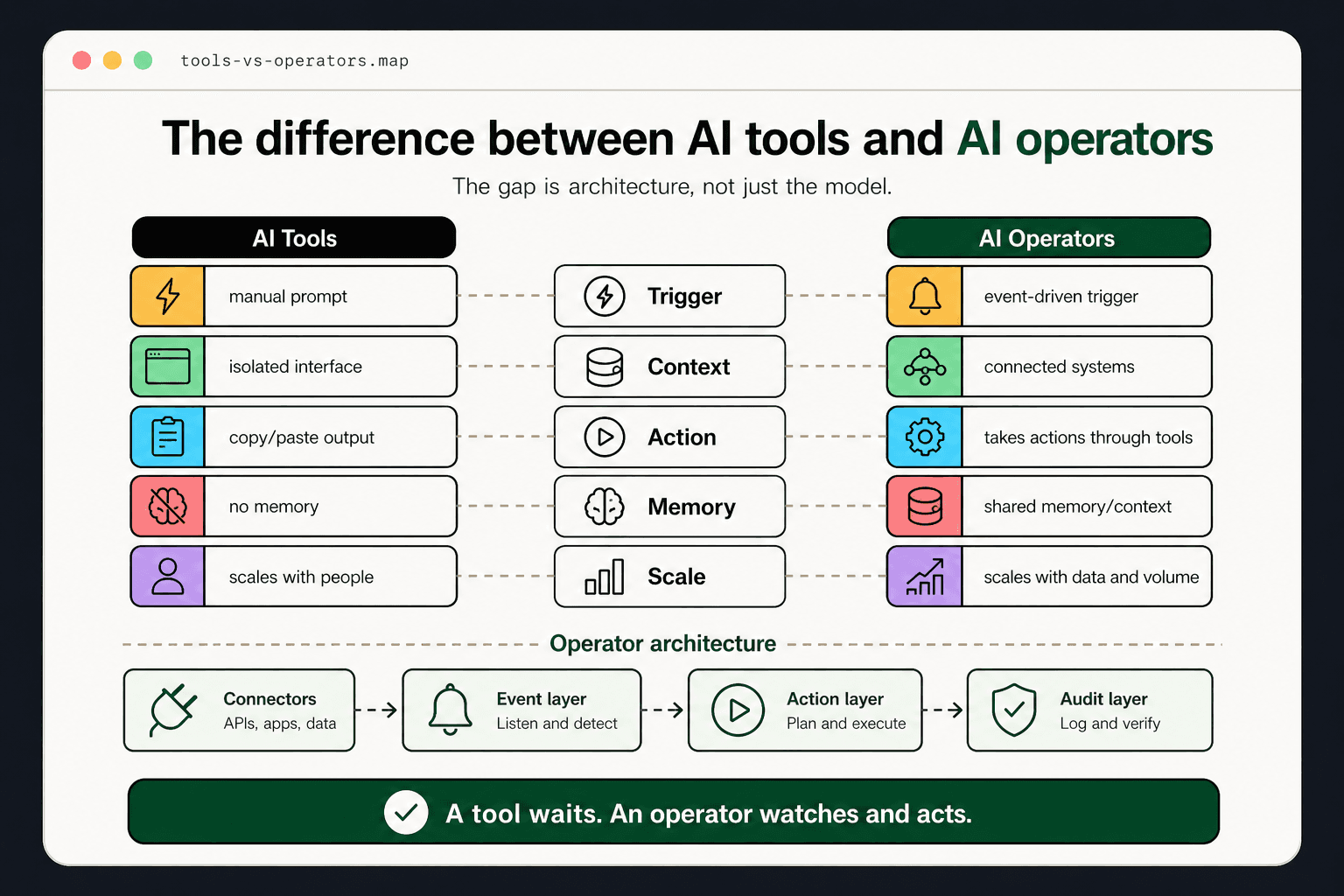
An AI tool responds when a human uses it. A team member opens a chat interface, writes a prompt, receives an output, and decides what to do with it. The tool has no context unless the human provides it. It takes no action unless the human copies the output somewhere.
AI tools are genuinely valuable. They make individual knowledge workers faster. But they do not change how the business operates — they change how individual people within the business work.
What an AI operator is
An AI operator monitors conditions, processes inputs when they appear, makes decisions within defined parameters, takes actions through connected systems, and creates a record of what it did and why.
An AI operator does not wait. It watches. When a new support ticket arrives, it classifies and routes it. When inventory crosses a threshold, it generates a purchase recommendation. When a customer account shows churn signals, it flags the account for an action queue.
The compounding advantage
Tools scale linearly with the humans using them. If you hire twice as many people, you get twice as much tool usage. Operators scale with data and volume. A single operator that handles order exception routing does not get more expensive when order volume doubles — it just processes more exceptions.
This is the compounding advantage that explains why businesses that invest in operators early create structural advantages over businesses that stay at the tool level.
What the architecture decision actually involves
The difference between a tool and an operator is not the model — it is the infrastructure around the model. Connectors that give the model access to live data. An event layer that triggers the model when conditions are met. An action layer that lets the model write to systems when its output warrants it. An audit layer that records every decision.
Building this infrastructure is the work of a B2B AI Workflow Audit and a pilot project. It is not months of development - it is disciplined design.
When to build the first operator
The right time to build the first AI operator is when you can identify a workflow that happens on a predictable trigger, requires a decision with documentable logic, and produces an output that goes somewhere specific.
That description fits dozens of processes in almost every business. The gap between identifying them and building the first operator is usually not technical — it is organizational. Somebody needs to decide that this is worth doing seriously.
Ready to act?