
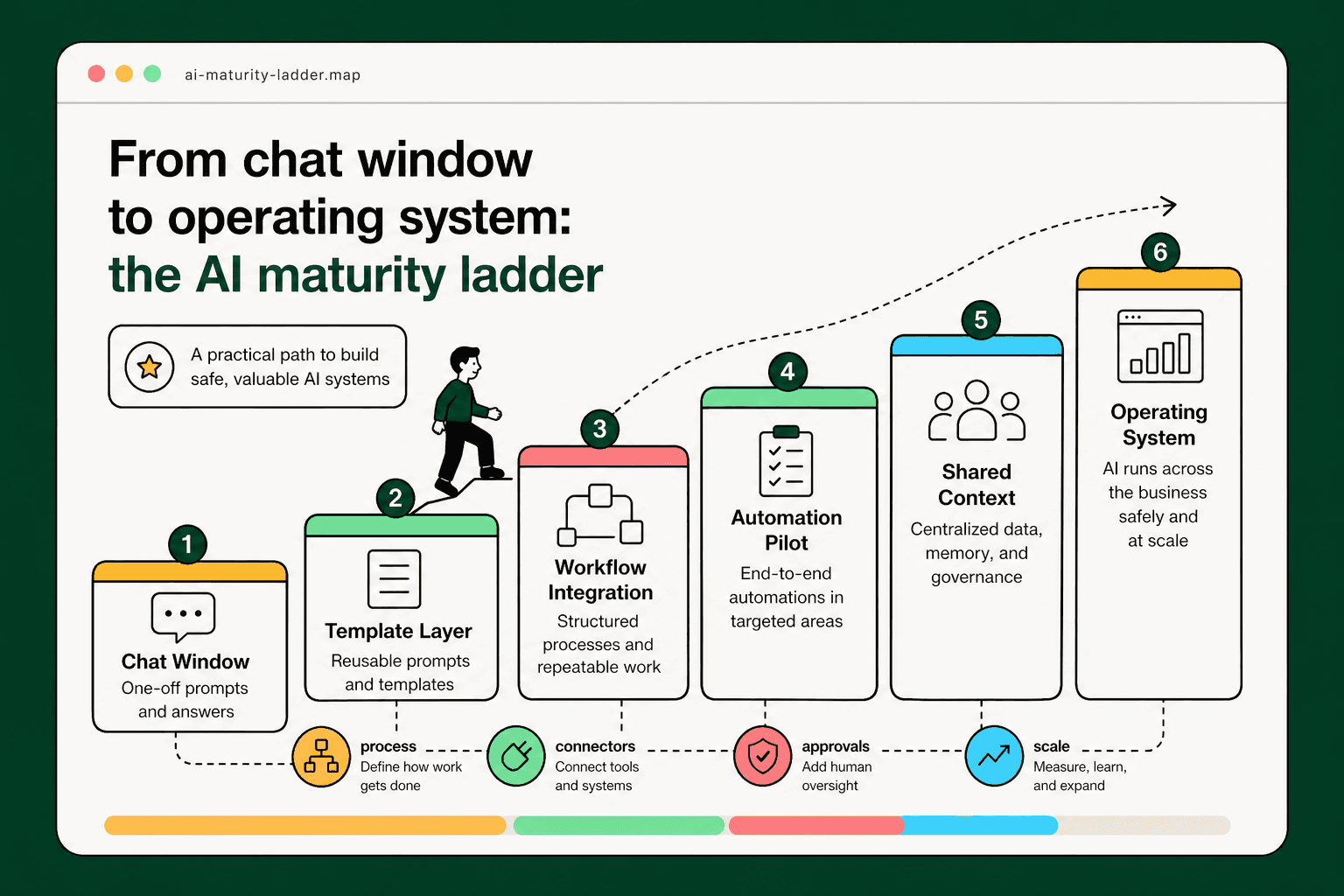
Level 1: The chat window
Most businesses encounter AI through a chat interface — a team member using Claude, ChatGPT, or Gemini for drafting, research, and Q&A. This is genuinely valuable but it is not a business capability. It is an individual productivity tool.
At level 1, the business has no systematic way to ensure consistent use, measure impact, protect sensitive information that might get typed into a public interface, or build on what individual team members discover.
Level 2: The template layer
Level 2 is when teams start building shared prompt libraries, standard operating procedures for AI use, and basic guardrails about what data can go into which tools.
This level is often skipped, but it is where organizational AI learning happens. Teams that skip level 2 and jump to automation are building on top of unexamined assumptions about how AI should be used in their specific context.
Level 3: The workflow integration
Level 3 connects AI to existing tools: a CRM, an inbox, a project management system. The AI assists with specific tasks within existing workflows rather than operating as a standalone chat tool.
This is where most 'AI-powered' SaaS tools live. They are valuable but they are also limited — constrained by the integration points the vendor chose to build, the data the vendor chooses to process, and the privacy policy the vendor maintains.
Level 4: The automation pilot
Level 4 is the first automated workflow: a process that runs without a human triggering each step, produces a measurable output, and creates an audit trail that can be reviewed.
Getting to level 4 correctly - with the right workflow, the right privacy architecture, and the right approval design - is what the B2B AI Workflow Audit is designed to support.
Levels 5 and 6: The operating system
At level 5, multiple automated workflows share context, learn from each other's outputs, and adapt based on outcomes. At level 6, the AI layer has become part of how the business operates — as fundamental as the accounting system or the CRM.
Businesses at level 6 do not talk about 'using AI.' They talk about what their operations team can now do that was previously impossible. The technology has receded into the infrastructure.
Ready to act?